Quick Tip: Create One-Click Photo Effects in Photoshop

Quick Tip: Create One-Click Photo Effects in Photoshop

Did you know that you can apply one-click color effects to your photos? It is very easy to do using the Color Lookup Adjustment Layer. In fact, it’s so easy that even an absolute beginner can apply beautiful color effects just by following this short tutorial.

Final image

Without getting into too many technical details, a color look-up table (CLUT) is a mechanism used mainly in video or photography to transform a range of input colors into another range of colors. While difficult to create, the Color Lookup Tables are very easy to apply, and Adobe has provided a nice amount of pre-loaded tables for you to use on your photos.

Let's open our base image. You can download this one here. If you plan to use this image in commercial work, just be sure to read the usage rights on the download page. Photo by Joel Bedford via Flickr.

Base image

%image_alt%

Click on the Adjustment Layers icon at the bottom right of the Layers palette and select Color Lookup from the menu.
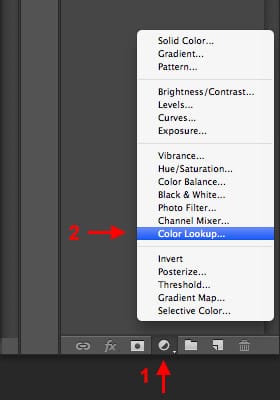
%image_alt%

The Color Lookup Palette will open up and you will see several options. Don't worry about those options; we will only concentrate on the pre-built tables.
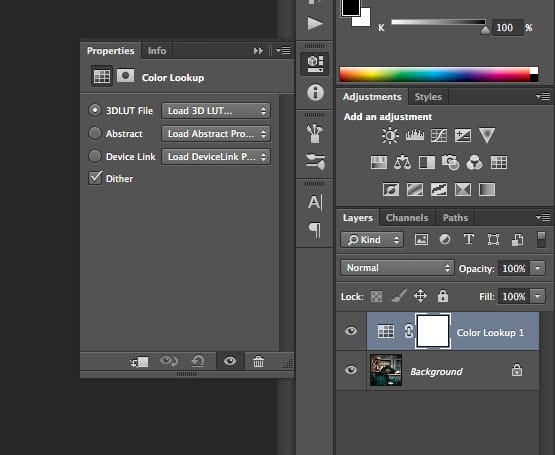
%image_alt%

Just click on the pulldown menus and select the table you want. Always click on the pulldown menu and not on the radio buttons, or you will be prompted to load a table to your list. Since we will be using the default tables, this is not necessary.

In this example, we will start with one of my favorites, the Horror Blue table.
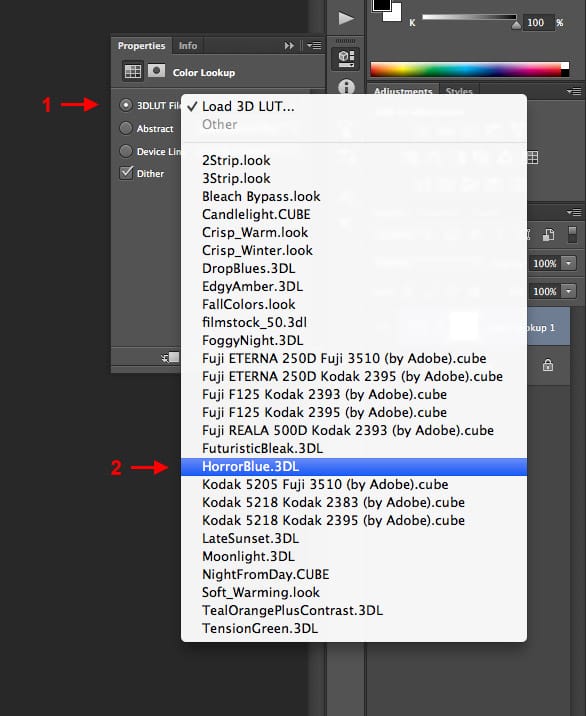
%image_alt%

And that's it! With just a single click, we applied an awesome color effect without messing around with curves, levels, and other complex techniques.

%image_alt%

Let’s see some other examples:

2 Strip Color Table

%image_alt%

Candle Light Color Table

%image_alt%

Film Stock 50 Color Table

CreativeLive

Get tutorials & freebies delivered to you.

Subscribe to the Photoshop Roadmap newsletter, a weekly roundup of new tutorials, insights and quality downloads, trusted by 6500+ readers.

You might also like

How to Enhance Skin Tones Using Gradients in Photoshop

Skin tones often appear washed out or lifeless in photographs due to challenging lighting conditions or camera settings. This gradient-based technique brings vibrancy back to portraits while creating natural-looking dimensional highlights that draw the viewer's eye to key facial features. The method uses Color Range selections combined with...

7 Signs You're a Photoshop Pro - Skill Assessment Guide

Professional Photoshop mastery isn't about memorizing every menu or filter. It's about developing efficient workflows, understanding core concepts, and building muscle memory for essential techniques. Real pros focus on the right tools for their specific needs rather than trying to learn everything. This comprehensive assessment covers...

How to Use Generative Upscale with Multiple AI Models in Photoshop

Pixelated vintage photos and low-resolution images no longer need to stay small. Photoshop's Generative Upscale feature now offers multiple AI models to enlarge images up to 4x their original size while adding remarkable detail and clarity. This new feature includes three distinct AI models—Adobe's Firefly...

Create a Pointillism Effect in Photoshop

Pointillism, the late 19th-century painting technique that uses small dots of color to form images, creates a distinctive artistic look where colors blend optically when viewed from a distance. This digital recreation technique transforms ordinary photographs into artwork that mimics the style of masters like Paul Signac. The process combines...

How to Convert WebP to JPEG in Bulk Using Image Processor

Converting large folders of WebP images to JPEG format can be time-consuming when done manually. Image Processor provides an efficient solution for batch conversion, automatically handling multiple files while maintaining quality settings and organization. This method works with any image format conversion and creates organized output folders, making it ideal...

How to Use Generative Credits in Adobe Creative Cloud: Standard vs Premium Features

Adobe's generative AI features transform how creatives work, but understanding which tools consume credits can save you time and budget frustration. The credit system divides features into standard and premium tiers, with different consumption rates based on processing complexity. Knowing the difference between assistive AI tools that cost...

You’ve successfully subscribed to Photoshop Roadmap
Welcome back! You’ve successfully signed in.
Great! You’ve successfully signed up.
Success! Your email is updated.
Your link has expired
Success! Check your email for magic link to sign-in.