Turn a Photo Into an Architect’s Blueprint Drawing in Photoshop

Turn a Photo Into an Architect’s Blueprint Drawing in Photoshop

Architectural blueprints offer a distinct, professional aesthetic, traditionally outlining designs with precision and clarity. This iconic style, with its characteristic blue tones and crisp lines, is often associated with the early stages of building visualization.

This tutorial demonstrates how to transform any photograph of a structure into a realistic blueprint drawing. It walks you through the essential Photoshop steps, allowing you to replicate this classic design document appearance digitally.

Watch the Video

Video by Blue Lightning. Any links or downloads mentioned by the creator are available only on YouTube

Emulating Traditional Blueprint Aesthetics Digitally

Architectural blueprints have long served as the universal language for translating conceptual designs into tangible structures. These technical drawings, traditionally produced through a contact print process on light-sensitive paper, convey precise measurements, materials, and construction details. The distinct white lines on a blue background are not merely aesthetic; they were a practical result of the light-sensitive chemical process.

In contemporary design, replicating this classic blueprint look goes beyond mere utility, tapping into a rich visual heritage. Digital tools allow designers to interpret photographic realism into more illustrative or schematic forms. This emphasizes core structure and design elements rather than superficial details.

This artistic choice aligns with non-photorealistic rendering (NPR), a field focused on generating images in diverse artistic styles. Recreating the blueprint effect in a digital medium offers a unique blend of historical aesthetic and modern flexibility for presenting architectural concepts.

Practical Tips for Blueprint Transformations

  • Use the Find Edges filter as a starting point for line work.
  • Apply Levels adjustments to fine-tune the lightness and contrast of the initial drawing, customizing it to your specific image.
  • Utilize Clipping Masks to ensure texture and color layers affect only the underlying blueprint layer, maintaining a clean workflow.
  • Incorporate distressed brushes on layer masks to create rough, hand-drawn edges and borders, enhancing authenticity.
  • Experiment with alternative blend modes, such as Screen for the blueprint color or Linear Burn for textures, to achieve varied visual effects.

More Tutorials about Photo to Drawing Effects

Explore other creative Photoshop techniques to transform your photographs into various artistic styles.
Apply a beautiful watercolor effect to an architectural rendering in Photoshop
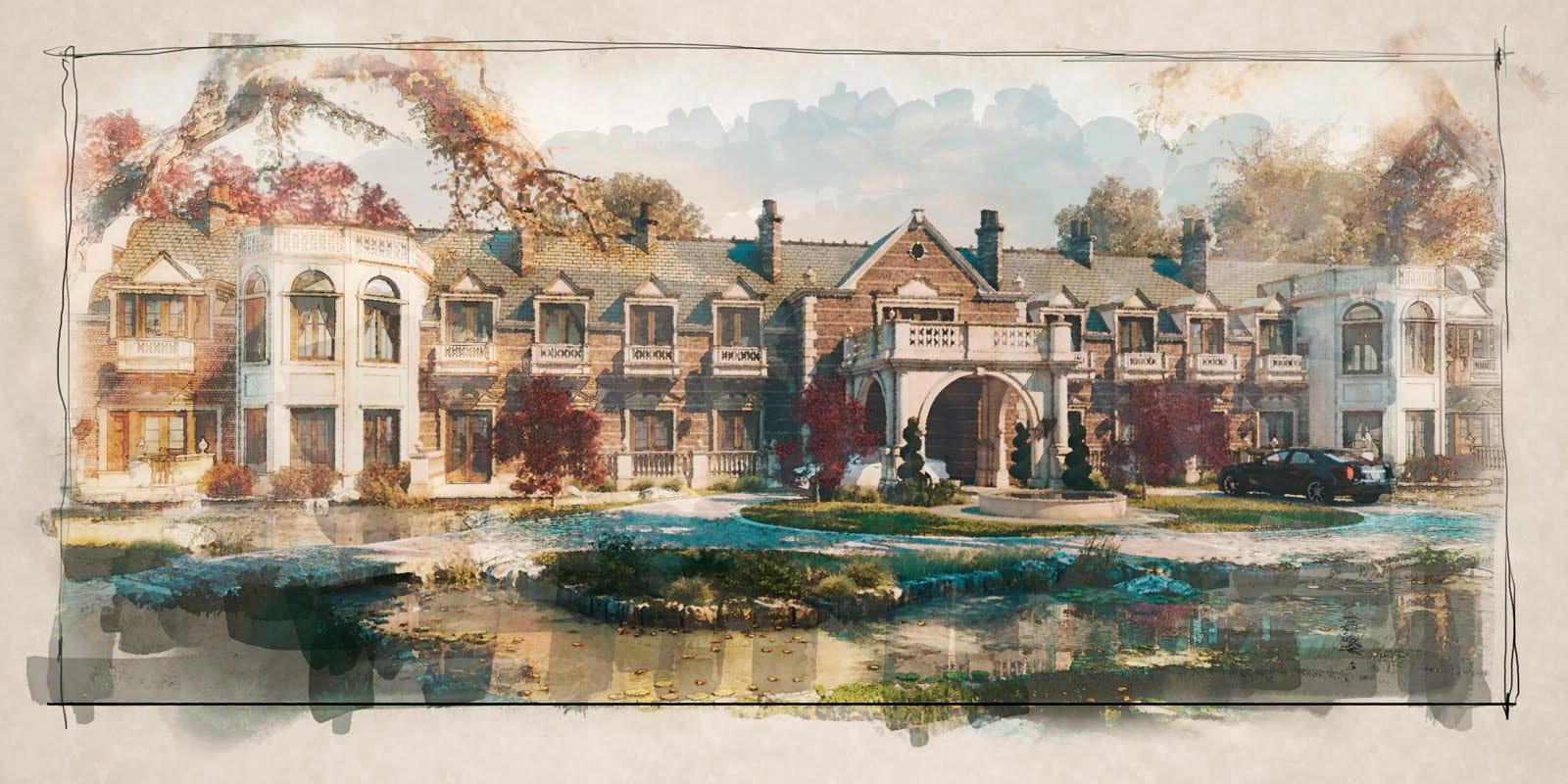
In this tutorial, the author attempts to take a rendering they made some time ago using Autodesk 3ds Max and V-Ray, and turn it into a watercolor painting, or something that is NPR (non-photo real). They use Photoshop software to mimic the effect, building layer upon layer of digital paint. The author uses many different Photoshop techniques to achieve the watercolor effect, with the expectation that the reader can mix and match the techniques and come up with their own watercolor workflow in P
Turn a Photo into a Pencil Sketch Drawing in Photoshop
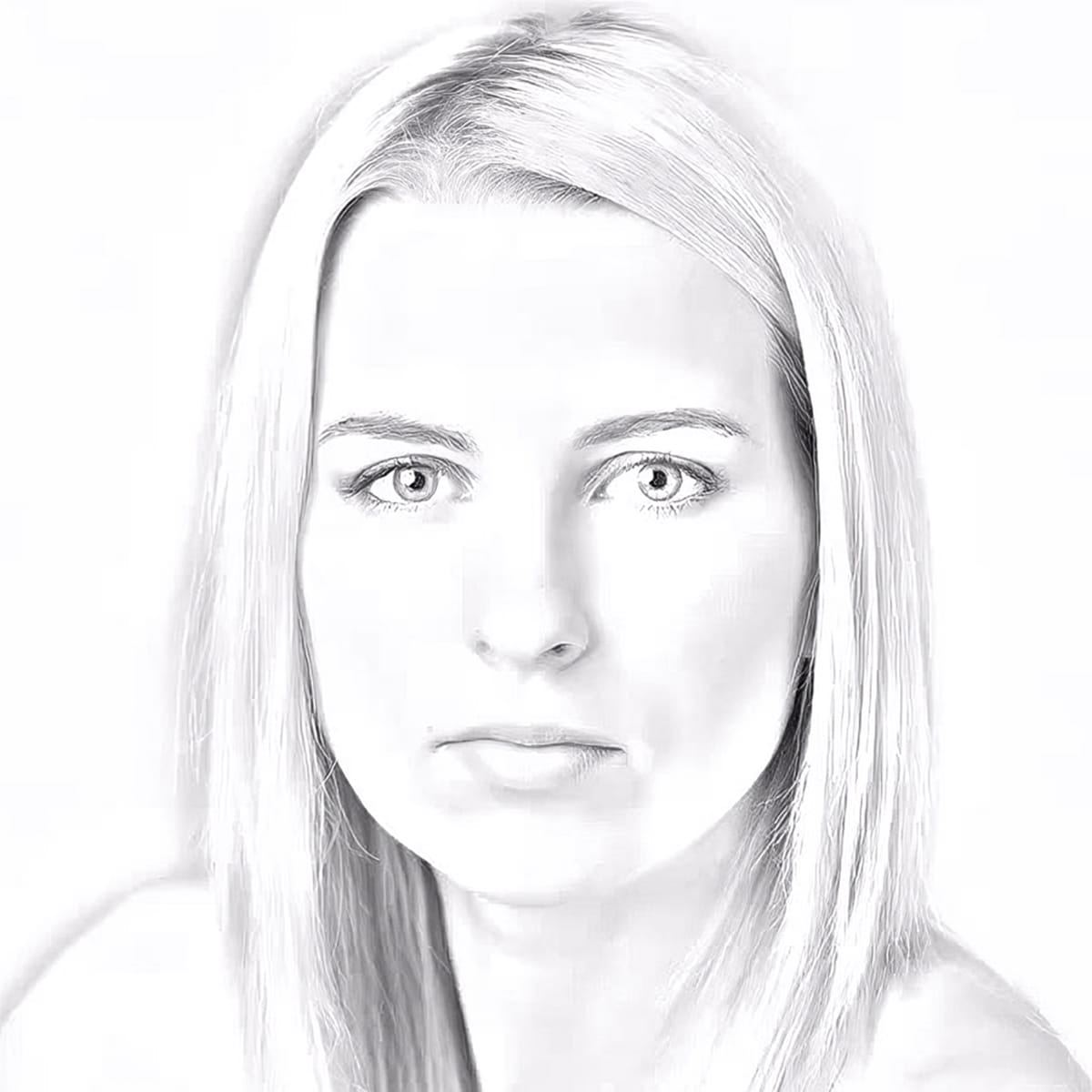
In this Photoshop tutorial by Tony from Psych Studio, learn to transform photos into realistic pencil sketches using advanced techniques. The instructor avoids basic filters, focusing on duplicating layers, desaturating images, and applying precise blending modes like Gaussian blur to mimic authentic pencil strokes. This approach ensures sketches maintain a natural, hand-drawn quality rather than a digital filter appearance. Ideal for designers seeking to integrate a hand-drawn look into digita
How to Make a Bauhaus Inspired Graphic Design in Photoshop
This tutorial offers an engaging approach to creating a Bauhaus-inspired graphic design using Photoshop CS6. Perfect for both beginners and seasoned designers, it guides you through the process of designing a vibrant, modernist piece that features a name. You will learn to incorporate fundamental elements of the Bauhaus style, including bold color palettes and geometric shapes. The tutorial breaks down each step, ensuring you understand how to manipulate various tools and layers within Photosho
Turn your photo into a pencil sketch in Photoshop
In the world of Photoshop, some effects are timeless classics. Turning a portrait photo into a sketch is one of them. With just a few simple clicks, any portrait can be turned into a beautiful drawing, and any photographer can feel like an accomplished graphic artist. In this tutorial, Steve Patterson from Photoshop Essentials guides you step by step as you learn how to easily convert any portrait into a black and white pencil sketch with Photoshop. But it doesn’t end there. Steve also shows yo

Get tutorials & freebies delivered to you.

Subscribe to the Photoshop Roadmap newsletter, a weekly roundup of new tutorials, insights and quality downloads, trusted by 6500+ readers.

You might also like

Create a Liquid Gel Logo Effect in Photoshop

Liquid gel effects transform flat logos into dimensional, glossy designs that appear to bubble and flow. This technique uses multiple layer styles and strategic duplication to build depth, creating surfaces that catch light like thick, viscous liquid. The method combines gradient overlays, bevel effects, and inner glows across several duplicated...

How to Use Photoshop's AI Sharpen Filter and When It's Worth the Cost

Photoshop's new AI Sharpen filter promises one-click sharpening powered by advanced algorithms. This tool uses technology from Topaz Labs to enhance image details without manual adjustments, but it comes with a significant cost in credits. Understanding when to use this automated approach versus traditional methods like the High...

How to Use Harmonize and Generative Upscale Tools in Photoshop

Creating realistic photo composites requires matching lighting and color between different images—a traditionally time-consuming process. Two new AI-powered tools in Photoshop solve these challenges: Harmonize automatically adjusts lighting and shadows to blend subjects seamlessly into backgrounds, while Generative Upscale enlarges small images without losing detail. These tools work together...

How to Create Convincing Scale Effects in Photoshop Composites

Creating believable scale effects requires more than simply resizing objects—it demands understanding how light, perspective, and atmospheric conditions change with distance. When tiny subjects appear massive or giant objects seem miniature, viewers should feel the illusion is completely natural. This technique combines careful attention to lighting consistency, depth cues,...

How to Flip Images Horizontally and Vertically in Photoshop

Flipping images is a fundamental technique that can dramatically change the composition and impact of your photos. Whether you need to correct the orientation of a subject, create mirror effects, or simply improve the visual flow of your design, knowing how to quickly flip images both horizontally and vertically gives...

How to Use Nano Banana Pro in Photoshop for Background Replacement and Scene Changes

Nano Banana Pro transforms how you place subjects into new environments in Photoshop. This advanced AI model maintains perfect subject likeness while seamlessly integrating them into any background you can imagine. The tool excels at matching lighting, preserving facial features, and even adapting clothing to complement new scenes, all through...

You’ve successfully subscribed to Photoshop Roadmap
Welcome back! You’ve successfully signed in.
Great! You’ve successfully signed up.
Success! Your email is updated.
Your link has expired
Success! Check your email for magic link to sign-in.